
Tariff Flowchart - How does Section 232 Work?

New Tariff Rules Took Effect April 23, 2026. Here's What Importers Need to Check.
If your business buys things from overseas, the U.S. government just updated the tariff rules again. The latest update is called HTS Revision 6. It took effect April 23, 2026.
Don't panic. The update is mostly small fixes, not a whole new system. But the rules around steel, aluminum, and copper changed for the second time in two weeks, and there are a few things every importer should double-check before their next shipment lands.
Here's a plain-English checklist.

Flow Charts
Sec. 232 Semiconductors
Sec. 232 Automobile and Automobile Parts
Sec. 232 MHDV, MHDV Parts, and Buses
Sec. 232 Steel, Aluminum, and Copper
Sec. 232 Timber and Lumber
What is this, exactly?
Tariffs are taxes on goods coming into the country. The rules for which goods get taxed, how much, and from where are listed in a giant book called the Harmonized Tariff Schedule (HTS). The book gets updated several times a year. Rev. 6 is the sixth update of 2026.
Right now, two big buckets of tariffs sit on top of normal duties:
Section 232 taxes specific industries (cars, steel, semiconductors, lumber, and so on)
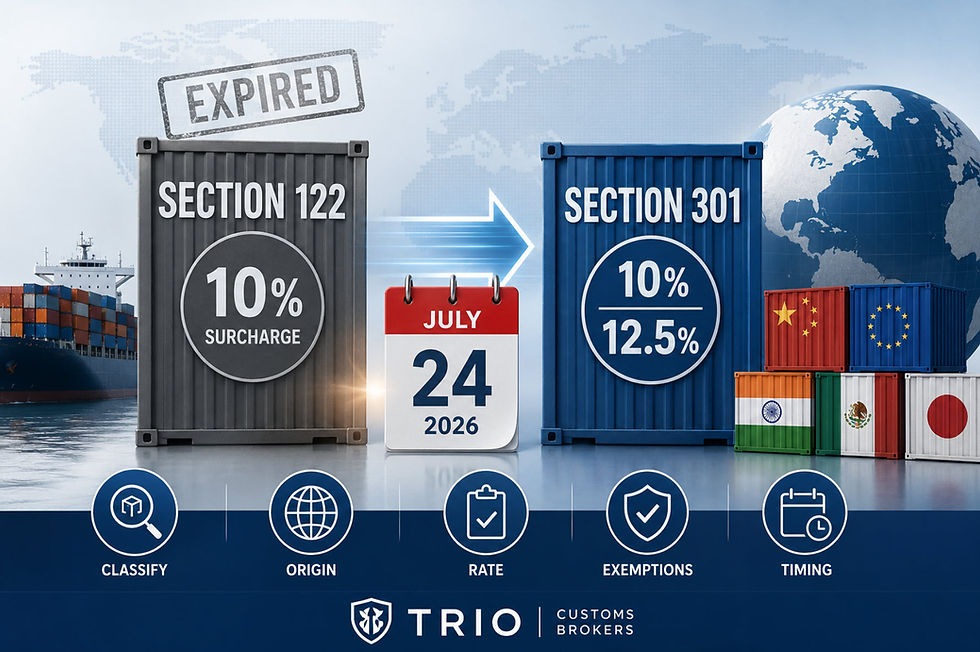
Section 122 is a 10% tax on almost everything from almost everywhere, with some exceptions
Most of the work in this checklist is figuring out which buckets apply to your products and whether you qualify for any exceptions.
1. Check whether your product is on a tariff list
Each Section 232 program has its own list of products. The lists move. A part that was exempt three months ago may not be exempt today. The opposite also happens.
Pull the current list from CBP (Customs and Border Protection) for every product you import. Don't trust your memory or last quarter's spreadsheet. The single most common mistake right now is filing entries against an old list.
If your product shows up on more than one list, the order matters. Auto and truck parts get checked first. Steel and aluminum stack with most other taxes but not with the 10% Section 122 tariff.
2. If you use Chapter 98, double-check it
Chapter 98 is a special part of the tariff book that gives breaks for things like American goods being sent back home, repairs done overseas, and goods assembled abroad from U.S. parts. It's a real money-saver when used correctly.
Two warnings:
Repairs done overseas (subheading 9802.00.60). Under the new rules, if your goods are subject to Section 232, you pay the additional duty on the full value of the imported article, not just the value of the repair. That's a significant change.
Assembly abroad (subheading 9802.00.80). For Section 122, the 10% applies to the value assembled overseas, minus the cost of the U.S. parts you sent over. Make sure your paperwork breaks out U.S. content clearly. Without it, you'll get taxed on the whole value.

3. Verify your country-of-origin and trade deal claims
Different countries get different rates. Trade deals like USMCA (Canada and Mexico) and special arrangements with the UK, Japan, the EU, and South Korea each route to different tariff codes.
Quick reference for cars and car parts:
Where it's from | What you do |
Canada or Mexico (USMCA) | Certify U.S. content. U.S. portion is duty-free, foreign portion is 25%. |
UK | Cars: tariff-rate quota. Parts: 10% combined rate. |
Japan, EU, South Korea | If the normal rate is already 15% or more, no extra duty. If less than 15%, the combined rate is 15%. |
Everywhere else | 25% additional. |
If you're claiming a trade deal benefit, your records need to back it up. The certification, the proof the part was used in U.S. production or repair, and the exclusion of certain steel-heavy categories all need to be in the file.
4. Look at your steel, aluminum, and copper imports carefully
This is the part that just changed. Twice. Steel, aluminum, and copper articles now sort into three buckets called Annex I-A, I-B, and III. Each bucket has a different rate.
Bucket | Default rate | UK rate | "Made with U.S. metal" rate |
Annex I-A (the heaviest) | 50% | 25% | 10% |
Annex I-B | 25% | 15% | 10% |
Annex III (temporary) | 15% | n/a | 10% or 0% |
Two things to know:
Annex III is going away. It expires December 31, 2027, and those products move into Annex I-B on January 1, 2028. If your sourcing depends on Annex III rates, start planning now. You have about 20 months.
The 95% rule. If at least 95% of the metal in your product was melted, poured, smelted, or cast in the United States, you can claim a reduced 10% rate. Document where the metal was made. Without proof, you pay the full rate.
There's also an escape hatch for products that contain only a little metal. If your product is classified outside the metal chapters and the metal weighs less than 15% of the total, you can use code 9903.82.03 and skip the metals tariff entirely.
5. Don't miss the Section 122 exemptions
Section 122 looks like a flat 10% tariff on everything, but there are eleven exemption codes. The ones most importers actually use:
In-transit goods loaded before February 24 with entry filed before February 28
Civil aircraft and parts
Goods already subject to Section 232 (use code 9903.03.06 to claim this one)
USMCA-qualifying goods from Canada or Mexico
Donations and informational material
If your product is paying a Section 232 tax, make sure your customs broker is also claiming the Section 122 exemption. They are not the same code. Both need to be on the entry.
6. Revisit your drawback claims
Drawback is a refund program for taxes paid on imports that get exported again or used in U.S. manufacturing. The rules just opened up for two big categories:
Auto parts and truck parts are now eligible for two types of manufacturing drawback as of November 1. If you paused drawback claims during 2025, restart them.
Lumber and timber are eligible.
Section 122 is eligible.
Semiconductors are not eligible. Don't bother filing.
Drawback paperwork takes time to set up but the refunds are real. For a manufacturer running a U.S. production line on imported parts, this can return six or seven figures a year.
The bottom line
The rules will keep changing. Two updates in three weeks for steel, aluminum, and copper isn't a coincidence. More refinements are likely.
The work for any importer right now is the same as it always is. Check current lists. Document where things came from and what they're made of. Claim the exemptions you qualify for. Don't claim the ones you don't.
If any of this feels unclear, it's worth a conversation with a licensed customs broker before your next entry. The cost of getting it wrong has gone up a lot in the past year.
Disclaimer: The information contained in this document is intended to convey general information only and does not constitute legal advice or opinions. The contents of this document should not be construed as, and should not be relied upon for legal advice in any particular circumstance or fact situation. No action should be taken in reliance on the information contained in this document, TRIO, and NCBFAA disclaims all liability in respect to actions taken or not taken based on any or all of the contents of this document to the fullest extent permitted by law. An attorney should be contacted for advice on any legal issues. Thank you very much for your cooperation.


Comments