
Customs Bond Sufficiency and Rising Duty Exposure: What Importers Need to Know

Updated: Jul 27
Importers are facing a more complicated duty environment than ever. Normal customs duty is only one part of the total cost. Many importers may also face Section 301 tariffs, Section 232 steel or aluminum duties, antidumping and countervailing duties, merchandise processing fees, harbor maintenance fees, and other CBP charges.
FREE BOND CALCULATOR (simulator)

As duty exposure rises, one issue becomes more important: customs bond sufficiency.
A customs bond is not just paperwork. It is a financial guarantee to U.S. Customs and Border Protection that the importer will meet its customs obligations, including the payment of duties, taxes, and fees. If the bond amount is too low, importers can face delays, bond insufficiency notices, requests for higher bond amounts, or the need for additional security.
What is customs bond sufficiency?
Customs bond sufficiency means that the importer’s bond amount is large enough to cover the risk associated with its import activity.
For ongoing importers, the most common bond is an Activity Code 1 continuous import bond. CBP explains that a continuous bond amount is generally based on 10 percent of the duties, taxes, and fees paid during the prior 12 month period. CBP also states that a single entry bond is generally not less than the total entered value, plus duties, taxes, and fees.
That 10 percent calculation sounds simple, but the real world can become complicated quickly. If an importer’s duty exposure increases, the bond that was sufficient last year may not be sufficient today.

Why rising duties can create bond problems
Many importers set up a continuous bond when their duty exposure is relatively low. Later, the company’s risk profile changes.
Common reasons include:
Higher import volume
Higher customs value
New suppliers or countries of origin
New tariff classifications
Section 301 China duties
Section 232 steel or aluminum duties
Antidumping or countervailing duty exposure
A new product line with a higher duty rate
A change from occasional imports to regular imports
A large shipment that is outside the importer’s normal pattern
When this happens, the importer may unknowingly exceed the practical protection of its bond. CBP’s bond guidance explains that bond amounts are tied to the risk presented by the transaction and the obligations secured by the bond. CBP maintains public bond resources, including its guide on how CBP sets bond amounts.
Example: How duty exposure can outgrow the bond
Assume an importer has a $50,000 continuous customs bond.
Historically, the importer paid $300,000 per year in duties, taxes, and fees. Under the general 10 percent formula, a $50,000 bond may have been enough.
Now assume the importer begins importing a larger volume of China origin metal parts subject to additional tariff exposure. The company’s annual duties, taxes, and fees increase to $900,000.
Ten percent of $900,000 is $90,000.
In that example, the importer may need to increase its continuous bond from $50,000 to at least $90,000, usually rounded according to the applicable bond amount practices.
This is why importers should not treat a customs bond as a once per year renewal item. It should be reviewed whenever duty exposure changes.
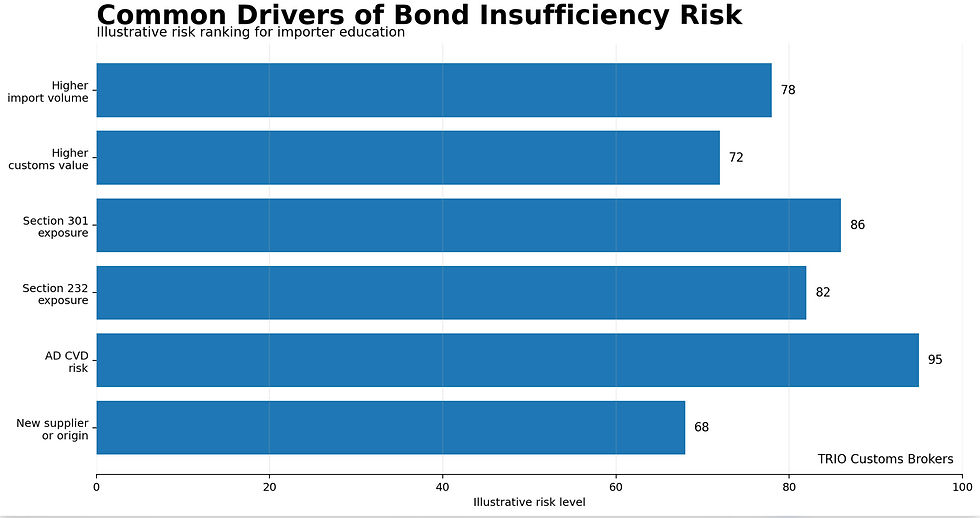
Why Section 301, Section 232, and AD CVD matter
Additional duty programs can cause bond exposure to rise quickly.
Section 301 duties on China origin goods can add a significant tariff layer beyond the ordinary duty rate. Section 232 duties on certain steel, aluminum, and derivative products can also create additional duty exposure. Antidumping and countervailing duty cases can create even more serious exposure because rates may be high and final liability may not be known until later.
CBP has specific guidance on the possible use of additional security, including single transaction bonds, in certain antidumping and countervailing duty situations. CBP states that additional security may be required only on a case by case basis, depending on the facts of the import transaction.
For importers, the message is simple: if your products are subject to trade remedies, your bond should be reviewed more often.
What can happen if your bond is insufficient?
An insufficient bond can create practical problems for the importer.
Possible consequences include:
Entry delays
Requests for a larger bond
Need for a new continuous bond
Need for a single entry bond on a specific shipment
Increased surety review
Higher bond premium
Added documentation requirements
Disruption to shipment release
Internal accounting surprises
Compliance scrutiny
CBP’s monetary guidelines explain that when a continuous bond does not cover the duty on a particular shipment, CBP may request a single entry bond for that shipment or request that a new continuous bond in a higher amount be filed.
That means a bond issue can become a cargo release issue.
Continuous bond vs single entry bond
A continuous bond is usually used by importers that import regularly. It covers import activity over time and may be used across ports and brokers, as long as the bond is active and properly connected to the importer.
A single entry bond is used for one specific import transaction. CBP explains that a single entry bond is generally calculated in an amount not less than the entered value, plus duties, taxes, and fees.
For many regular importers, a continuous bond is more practical. But if a shipment is unusually large, unusually high duty, or involves higher risk merchandise, CBP or the surety may require additional review or additional security.
When should an importer review its bond?
Importers should review bond sufficiency before a problem occurs.
A bond review is especially important when:
Annual duty, tax, and fee payments are increasing
The importer adds China origin products
The importer adds steel or aluminum products
The importer enters products that may be subject to AD CVD
The importer changes HTS classifications
The importer starts a new supplier program
The importer increases import volume
The importer changes importer of record structure
The importer opens a new division or affiliate
The importer receives a bond insufficiency notice
The importer has a large shipment coming soon
The importer has multiple brokers filing under the same bond
The best practice is to review both the past 12 months and the expected next 12 months. A bond that was sufficient based on historical activity may not be sufficient if future imports will be larger or more duty intensive.

Information needed for a bond sufficiency review
To review bond sufficiency, importers should gather:
Importer of record number
Current continuous bond amount
Current surety information
Prior 12 months of duties, taxes, and fees
Expected next 12 months of import activity
Estimated customs values
HTS classifications
Countries of origin
Known Section 301 or Section 232 exposure
Any possible AD CVD exposure
Number of expected shipments
Ports of entry
Brokers filing under the importer’s bond
Any CBP notices or surety communications
Any planned product, supplier, or sourcing changes
This information helps determine whether the current bond is likely to remain sufficient.
Common mistakes importers make
The first mistake is assuming the bond amount is automatically correct because the bond renewed. Renewal does not always mean the bond is properly sized for current activity.
The second mistake is looking only backward. The prior 12 months matter, but future duty exposure matters too. If import volume or tariff exposure is about to increase, the importer should address the bond before the shipments arrive.
The third mistake is ignoring trade remedy duties. Section 301, Section 232, and AD CVD exposure can change the bond calculation dramatically.
The fourth mistake is using multiple brokers without monitoring total duty exposure. A continuous bond may be used across multiple brokers, but the importer still needs to understand total activity under the bond.
The fifth mistake is waiting for CBP or the surety to identify the issue. By that point, cargo may already be at risk of delay.

What TRIO Customs Brokers can do
TRIO Customs Brokers can help importers review their customs activity and identify whether rising duty exposure may create a bond sufficiency issue.
TRIO can help with:
Reviewing prior entry activity
Estimating duties, taxes, and fees
Identifying tariff layers that may increase exposure
Reviewing Section 301 and Section 232 impact
Flagging possible AD CVD concerns for further review
Coordinating with the importer and surety
Helping importers understand continuous bond and single entry bond options
Preparing importers before a bond issue affects cargo release
TRIO does not replace the surety company, and TRIO does not make final CBP bond determinations. But TRIO can help importers understand the customs data behind the risk and coordinate the next steps.
Practical checklist for importers
Before your next major shipment, ask these questions:
What is my current continuous bond amount?
How much did I pay in duties, taxes, and fees over the last 12 months?
Will my import volume increase over the next 12 months?
Am I importing more goods from China?
Are my products subject to Section 301 duties?
Are my products subject to Section 232 duties?
Could any products be subject to AD CVD?
Have my HTS codes changed?
Have my countries of origin changed?
Are multiple brokers using the same bond?
Do I have a large shipment coming soon?
Have I received any notice from CBP or my surety?
If the answer to any of these questions raises concern, it is time to review bond sufficiency.
Bottom line
Customs bond sufficiency is becoming more important as importers face higher and more complicated duty exposure. A bond that was sufficient last year may not be sufficient today, especially if the importer has increased volume, higher customs values, China tariffs, Section 232 duties, or AD CVD exposure.
Importers should not wait until cargo is delayed or a bond insufficiency issue appears. The better approach is to review the bond before duty exposure changes.
TRIO Customs Brokers can help importers understand their customs activity, identify rising duty exposure, and prepare for bond sufficiency discussions before they become urgent.


Comments