
New Section 301 Tariffs Replace Much of the Expired Section 122 Exposure
- Adam C

- Jul 27
- 7 min read
Importers entered a new tariff environment on July 24, 2026.
The temporary Section 122 import surcharge expired at 12:01 a.m. Eastern Daylight Time on July 24, 2026. At nearly the same moment, a new group of Section 301 tariffs became effective on imports from 60 economies.
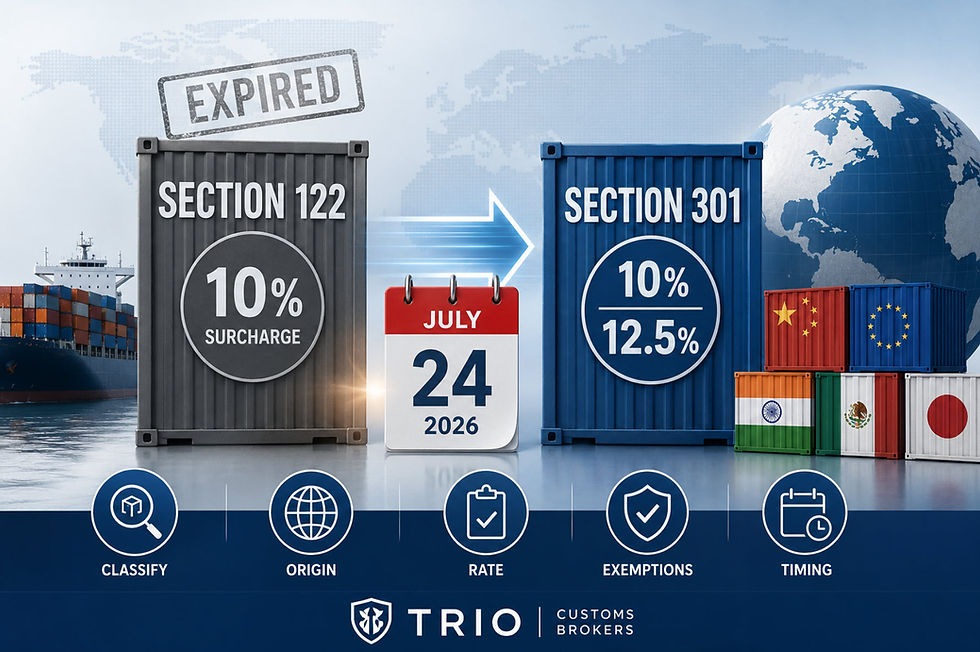
Although the two programs are legally distinct, the practical result for many importers is that the expiration of the Section 122 surcharge did not necessarily produce a meaningful duty reduction. For many countries and products, the former Section 122 exposure was replaced by new Section 301 duties of 10 percent or 12.5 percent. Importers should not assume that their tariff exposure disappeared simply because Section 122 expired.
What Was the Section 122 Surcharge?
Section 122 of the Trade Act of 1974 allows the President to impose a temporary import surcharge to address serious United States balance of payments problems.
The Section 122 surcharge imposed in February 2026 generally applied an additional 10 percent duty to imported merchandise, subject to exemptions. It became effective February 24, 2026 and was authorized to remain in effect through July 24, 2026 unless Congress extended it.
Because Section 122 is temporary by statute, the surcharge expired on July 24, 2026 without a congressional extension.
For some importers, that expiration removed the additional 10 percent duty. For many others, however, a new Section 301 tariff began applying at essentially the same time.
What Are the New Section 301 Tariffs?
On July 23, 2026, the Office of the United States Trade Representative announced final action under Section 301 of the Trade Act of 1974 following investigations involving 60 economies.
The investigations addressed whether those economies had failed to impose and effectively enforce prohibitions against importing products made wholly or partly with forced labor. USTR determined that the identified practices were unreasonable and burdened or restricted United States commerce.
The new duties became applicable to merchandise entered for consumption, or withdrawn from warehouse for consumption, on or after 12:01 a.m. Eastern Time on July 24, 2026.
The New Duty Rates
The applicable Section 301 rate depends primarily on the country of origin.
Countries Generally Subject to 10 Percent
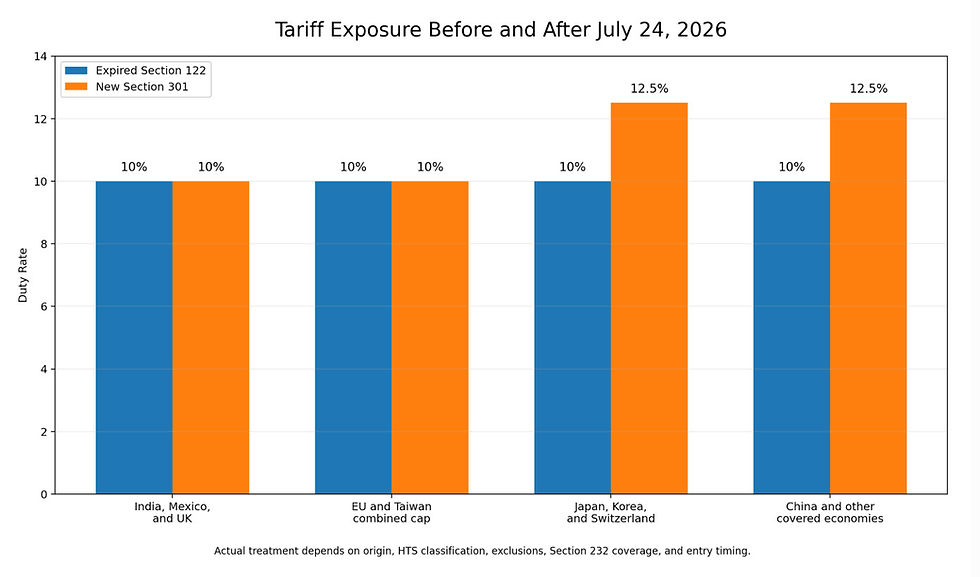
The new Section 301 tariff is generally 10 percent for goods originating in:
ArgentinaBangladeshCambodiaCanadaEcuadorEl SalvadorGuatemalaHondurasIndiaIndonesiaJordanMalaysiaMexicoPakistanSri LankaTrinidad and TobagoUnited Kingdom
These duties apply unless the merchandise qualifies for a specific product exemption.
European Union and Taiwan
For products originating in the European Union or Taiwan, the combined normal Most Favored Nation duty and the new Section 301 duty is generally capped at 10 percent.
For example:
If the normal duty rate is 2.5 percent, the Section 301 duty may be 7.5 percent.
If the normal duty rate is 6 percent, the Section 301 duty may be 4 percent.
If the normal duty rate is already 10 percent or greater, the new Section 301 duty may be zero.
This is an important distinction. It means that European Union and Taiwan imports are not necessarily assessed an additional 10 percent on top of the ordinary duty. Instead, the Section 301 amount may be calculated as the difference needed to bring the combined rate to 10 percent.
Japan, South Korea, and Switzerland
For Japan, South Korea, and Switzerland, the normal duty and new Section 301 duty are generally capped at a combined rate of 12.5 percent.
If the normal duty is below 12.5 percent, an additional Section 301 amount may apply to bring the combined rate to 12.5 percent.
If the normal duty is already 12.5 percent or greater, the Section 301 duty may be zero.
Other Covered Economies
Goods from the remaining covered economies are generally subject to an additional Section 301 tariff of 12.5 percent, unless an exemption applies.
China is included among the economies generally subject to the 12.5 percent rate under this new action. Importers must remember that this new tariff may exist alongside older China Section 301 duties and other applicable trade remedies.

Did Section 301 Legally Replace Section 122?
Not exactly.
Section 122 and Section 301 are separate legal authorities.
Section 122 addressed a national balance of payments issue and was temporary.
The new Section 301 tariffs are country specific trade actions intended to encourage foreign governments to impose and enforce prohibitions against forced labor imports.
However, from an importer’s financial perspective, the new Section 301 tariffs replaced much of the duty exposure that had existed under Section 122.
For example, an importer that previously paid a 10 percent Section 122 surcharge on an Indian or Mexican product may now face a 10 percent Section 301 tariff on the same product.
An importer of certain Chinese products may have moved from a 10 percent Section 122 surcharge to a 12.5 percent new Section 301 tariff, potentially increasing the duty burden by 2.5 percentage points.
The calculation must be performed at the individual HTS classification, country of origin, and entry level.
The July 28 In Transit Exception
A limited in transit exception may protect certain shipments from the new Section 301 duties.
Merchandise is not subject to the new duty when both of the following conditions are satisfied:
The goods were loaded onto a vessel at the port of loading and were in transit on the final mode of transportation before 12:01 a.m. Eastern Time on July 24, 2026.
The goods are entered for consumption or withdrawn from warehouse for consumption before 12:01 a.m. Eastern Time on July 28, 2026.
Both requirements must be satisfied. Merely clearing the merchandise before July 28 is not sufficient if it was not already loaded and in transit before the July 24 deadline.
Importers seeking to use this exception should preserve vessel loading records, bills of lading, departure information, arrival records, entry documentation, and other evidence establishing the shipment timeline.

Section 232 Products May Be Exempt
The new Section 301 notice includes exemptions for certain products, including articles and parts of articles subject to Section 232 tariffs.
This is especially important for automotive, steel, aluminum, copper, semiconductor, timber, and derivative product importers.
However, importers should not apply a broad assumption that every automotive or metal product is excluded. The treatment depends on the precise HTS classification, the applicable Section 232 program, the country of origin, and the language of the Section 301 annexes.
A product may also contain both covered and noncovered value or components. Entry treatment must follow the applicable Chapter 99 instructions and CBP guidance.
Product Exemptions Must Be Reviewed by HTS Code
USTR exempted numerous products based on considerations such as:
Domestic supply availability
Potential disruption to the United States economy
The inability to produce the product domestically in sufficient quantities or at reasonable prices
Whether imposing the tariff would meaningfully address the foreign practice being investigated
Commitments made by certain trading partners regarding forced labor import controls
The exemption lists are country specific and extensive. Importers should not rely solely on a general product description. The actual HTS classification and country specific annex must be reviewed.
Foreign Trade Zone Treatment
Merchandise subject to the new Section 301 duties that is admitted into a United States foreign trade zone generally must be admitted in privileged foreign status unless it is eligible for domestic status.
This treatment preserves the applicable Section 301 duty rate when the merchandise is later entered for consumption.
FTZ operators and importers should confirm that their admission procedures, inventory systems, CBP Form 214 filings, and entry instructions were updated as of July 24, 2026.
What Importers Should Do Now
Importers should immediately complete a structured tariff review.
Review Every Active HTS Classification
Determine whether each imported item is included in the new Section 301 program or qualifies for an exemption.
Confirm the Actual Country of Origin
Country of shipment is not necessarily country of origin. Section 301 liability generally follows the customs country of origin determined under applicable United States origin rules.
Compare the Before and After Duty Rates
The expiration of Section 122 may have produced one of several results:
No replacement tariff
A new 10 percent Section 301 tariff
A new 12.5 percent Section 301 tariff
A reduced net Section 301 amount based on the normal duty rate
An exemption because the product is subject to Section 232
A country specific or product specific exemption
Review July 24 Through July 28 Entries
Identify shipments that may qualify for the limited in transit exception. Supporting records should be collected before entry documents and transportation records become difficult to retrieve.
Update Landed Cost and Customer Pricing
Importers should update purchase orders, customer quotations, duty estimates, bond sufficiency calculations, and financial forecasts.
Even where the percentage remained at 10 percent, the legal authority and Chapter 99 reporting requirements changed.
Review Customs Bond Sufficiency
A new or increased Section 301 duty can materially increase the duties, taxes, and fees used by CBP to evaluate continuous bond sufficiency.
Importers with substantial annual volume should model their projected duty exposure rather than waiting for a CBP bond insufficiency notice.
Update Broker Instructions
Importers should provide their customs broker with current classification data, country of origin information, Section 232 applicability, exclusion claims, and supporting documentation.
A broker cannot properly claim an exemption if the importer has not provided sufficient product and sourcing information.
The Bottom Line
The expiration of Section 122 did not create a universal tariff reduction.
Beginning July 24, 2026, new Section 301 duties applied to imports from 60 economies. Many importers moved from a temporary 10 percent Section 122 surcharge to a new Section 301 tariff of 10 percent or 12.5 percent.
Others may receive lower effective treatment because of Most Favored Nation duty caps, Section 232 treatment, product exemptions, or the limited in transit exception.
Every importer should evaluate the result by country, HTS code, entry date, and applicable Chapter 99 provision.
How TRIO Customs Brokers Can Help
TRIO Customs Brokers can assist importers with:
HTS classification reviews
Country of origin analysis
Section 301 and Section 232 applicability
Product exemption reviews
In transit eligibility analysis
Entry and Chapter 99 reporting
Foreign trade zone treatment
Post entry corrections
Duty exposure forecasting
Customs bond sufficiency reviews
The new tariff environment requires more than applying a single percentage. Accurate entry treatment now depends on coordinating classification, origin, trade remedy programs, exemptions, entry timing, and supporting documentation.
Contact TRIO Customs Brokers to review how the July 2026 tariff changes affect your imported products.
This article is provided for general informational purposes and does not constitute legal advice. Tariff treatment depends on the specific facts, classifications, origin determinations, entry dates, and regulatory instructions applicable to each transaction.


Comments